What Amanda Learned to Notice
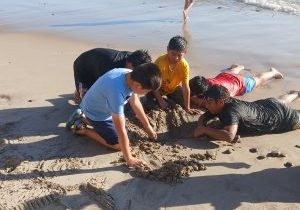
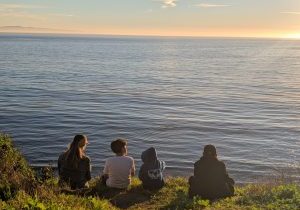
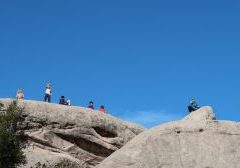
Amanda Gersoff and her sister started in 2008 at Wilderness Youth Project as summer camp and family camp participants. When they were older, they volunteered and worked as staff for a few years up until 2019. Below are a few photos she shared with us from past programs.
Now, Amanda is a restoration ecologist in Yosemite National Park, and she still does what W.Y.P. first taught her to do: she watches.
A new species of butterfly. A bird call she hasn't placed yet. The shape of a cloud that means weather is coming. These aren't idle observations. They're the same skill, practiced for years. "This sense of belonging and responsibility to care for nature shaped my educational path, career path, and essentially every major life decision I have made thus far," Amanda told us.
This is what happens when a child is given the same mentors, the same places, and the same invitation to pay attention, over and over, across years. W.Y.P.'s model has always worked this way. Small groups, relationship-based mentoring, kids returning to the same land and the same trusted adults long enough for something to take root.
Amanda is what taking root looks like with nearly twenty years to grow. Below are photos from Amanda working at Haleakalā and Yosemite National Parks.
Interconnection, not metaphor
Wilderness Youth Project's curriculum is built on self-directed exploration, naturalist skills, and awareness practices. This curriculum can lead to becoming an adult who has learned to get curious and ask questions like: "What is happening in this place, and what am I doing here?"
Amanda describes it plainly: "W.Y.P. helped me to understand interconnectedness within ecosystems, and my own place in the world." That's not a nature metaphor. It's a literal description of how watersheds, meadows, and the creatures in them function, and of where a person fits inside that, not above it.
You can see the through-line in her work now. In Yosemite, she studies the phenology of flowering plants, when they bud, when they bloom, and how that timing shifts from year to year. She traces how creeks meander through mountain meadows, reading the land the way she was taught to read a trail as a kid. Before Yosemite, she did conservation and restoration work in Sequoia and Kings Canyon, Yellowstone, and Haleakalā. A career built, park by park, on the same foundational skill: notice first, then act.
That way of seeing carried her into the classroom, too. Amanda holds a B.S. in Environmental Management and Protection, with minors in Land Rehabilitation & Restoration Ecology and Indigenous Studies in the Environment (‘21), and an M.S. in Environmental Sciences and Management from Cal Poly, San Luis Obispo (‘24). Her studies gave her technical language for something she says she learned first, outdoors, as a kid. The knowing came before the degrees. It’s the kind of knowing a child can carry anywhere: into a lab, a trade, a farm, a family, a life.
To all our families and supporters: Thank you for making life stories like this begin at Wilderness Youth Project.
A practice you can start today
You don't need a master's degree to practice what Amanda practices. Phenology (tracking when plants bud, flower, and fruit) is something you can do with a notebook and the same patch of ground, visited across a season.
Try this: pick one plant near where you live or work. Not a whole garden. One plant. Check on it once a week, same day if you can, and jot down three things: what it looks like, what's visiting it (insects, birds), and what the weather's been doing. After a few months, read your notes back. You'll start to see the patterns Amanda has built a career learning to read — the plant, the pollinator, the season, and you, all moving together.
Are you a W.Y.P. alum and want to share your story? We want to hear from you! Email us at Lauren@wyp.org.